NAalytics / Assemblies-of-putative-SARS-CoV2-spike-encoding-mRNA-sequences-for-vaccines-BNT-162b2-and-mRNA-1273
RNA vaccines have become a key tool in moving forward through the challenges raised both in the current pandemic and in numerous other public health and medical challenges. With the rollout of vaccines for COVID-19, these synthetic mRNAs have become broadly distributed RNA species in numerous human populations. Despite their ubiquity, sequences are not always available for such RNAs. Standard methods facilitate such sequencing. In this note, we provide experimental sequence information for the RNA components of the initial Moderna (https://pubmed.ncbi.nlm.nih.gov/32756549/) and Pfizer/BioNTech (https://pubmed.ncbi.nlm.nih.gov/33301246/) COVID-19 vaccines, allowing a working assembly of the former and a confirmation of previously reported sequence information for the latter RNA. Sharing of sequence information for broadly used therapeutics has the benefit of allowing any researchers or clinicians using sequencing approaches to rapidly identify such sequences as therapeutic-derived rather than host or infectious in origin. For this work, RNAs were obtained as discards from the small portions of vaccine doses that remained in vials after immunization; such portions would have been required to be otherwise discarded and were analyzed under FDA authorization for research use. To obtain the small amounts of RNA needed for characterization, vaccine remnants were phenol-chloroform extracted using TRIzol Reagent (Invitrogen), with intactness assessed by Agilent 2100 Bioanalyzer before and after extraction. Although our analysis mainly focused on RNAs obtained as soon as possible following discard, we also analyzed samples which had been refrigerated (~4 ℃) for up to 42 days with and without the addition of EDTA. Interestingly a substantial fraction of the RNA remained intact in these preparations. We note that the formulation of the vaccines includes numerous key chemical components which are quite possibly unstable under these conditions-- so these data certainly do not suggest that the vaccine as a biological agent is stable. But it is of interest that chemical stability of RNA itself is not sufficient to preclude eventual development of vaccines with a much less involved cold-chain storage and transportation. For further analysis, the initial RNAs were fragmented by heating to 94℃, primed with a random hexamer-tailed adaptor, amplified through a template-switch protocol (Takara SMARTerer Stranded RNA-seq kit), and sequenced using a MiSeq instrument (Illumina) with paired end 78-per end sequencing. As a reference material in specific assays, we included RNA of known concentration and sequence (from bacteriophage MS2). From these data, we obtained partial information on strandedness and a set of segments that could be used for assembly. This was particularly useful for the Moderna vaccine, for which the original vaccine RNA sequence was not available at the time our study was carried out. Contigs encoding full-length spikes were assembled from the Moderna and Pfizer datasets. The Pfizer/BioNTech data [Figure 1] verified the reported sequence for that vaccine (https://berthub.eu/articles/posts/reverse-engineering-source-code-of-the-biontech-pfizer-vaccine/), while the Moderna sequence [Figure 2] could not be checked against a published reference. RNA preparations lacking dsRNA are desirable in generating vaccine formulations as these will minimize an otherwise dramatic biological (and nonspecific) response that vertebrates have to double stranded character in RNA (https://www.nature.com/articles/nrd.2017.243). In the sequence data that we analyzed, we found that the vast majority of reads were from the expected sense strand. In addition, the minority of antisense reads appeared different from sense reads in lacking the characteristic extensions expected from the template switching protocol. Examining only the reads with an evident template switch (as an indicator for strand-of-origin), we observed that both vaccines overwhelmingly yielded sense reads (>99.99%). Independent sequencing assays and other experimental measurements are ongoing and will be needed to determine whether this template-switched sense read fraction in the SmarterSeq protocol indeed represents the actual dsRNA content in the original material. This work provides an initial assessment of two RNAs that are now a part of the human ecosystem and that are likely to appear in numerous other high throughput RNA-seq studies in which a fraction of the individuals may have previously been vaccinated. ProtoAcknowledgements: Thanks to our colleagues for help and suggestions (Nimit Jain, Emily Greenwald, Lamia Wahba, William Wang, Amisha Kumar, Sameer Sundrani, David Lipman, Bijoyita Roy). Figure 1: Spike-encoding contig assembled from BioNTech/Pfizer BNT-162b2 vaccine. Although the full coding region is included, the nature of the methodology used for sequencing and assembly is such that the assembled contig could lack some sequence from the ends of the RNA. Within the assembled sequence, this hypothetical sequence shows a perfect match to the corresponding sequence from documents available online derived from manufacturer communications with the World Health Organization [as reported by https://berthub.eu/articles/posts/reverse-engineering-source-code-of-the-biontech-pfizer-vaccine/]. The 5’ end for the assembly matches the start site noted in these documents, while the read-based assembly lacks an interrupted polyA tail (A30(GCATATGACT)A70) that is expected to be present in the mRNA.
- Stars
- 3,353 stars
- Forks
- 470 forks
- Language
- Not reported
- License
- Not reported
- Created
- Mar 24, 2021
- Last push
- Dec 14, 2021
- Updated
- Nov 9, 2026
Admitted to the Repository Index on Nov 11, 2026: 3,353 stars on 2026-11-11.
Star History
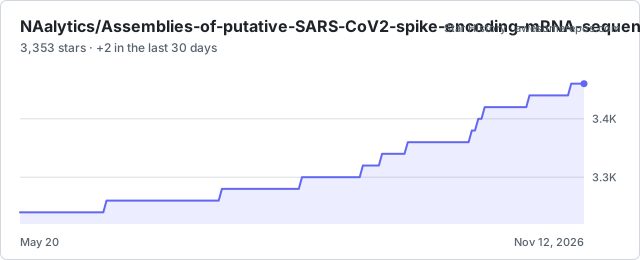
177 days recorded, May 20, 2026 – Nov 12, 2026 (UTC). Net change +12 stars.
The star count of each day is the latest count minus the net stars of the later days.
Add this Star History to a README
The images follow the light or dark theme of the page that shows them, and update every hour.
Add ?theme=light or ?theme=dark
to the chart address to keep one theme.
Star History chart
[](https://awesomerepos.com/NAalytics/Assemblies-of-putative-SARS-CoV2-spike-encoding-mRNA-sequences-for-vaccines-BNT-162b2-and-mRNA-1273) Badge

[](https://awesomerepos.com/NAalytics/Assemblies-of-putative-SARS-CoV2-spike-encoding-mRNA-sequences-for-vaccines-BNT-162b2-and-mRNA-1273) Timeline
It gained stars on 12 of the 177 days recorded since May 20, 2026.
Its largest 7 days were Oct 6, 2026 to Oct 12, 2026: 3 stars.
In the 30 days to Nov 12, 2026 it got 2 stars, 50% fewer than in the 30 days before.
It had 3,341 stars before May 20, 2026 and has 3,353 stars now: 1,647 fewer than 5,000.
- Created on the Repository Host
- Latest push
- Largest star day recorded: +1 stars
- +1 stars in one day
- +1 stars in one day
- Entered the Repository Index: 3,353 stars on 2026-11-11
The timeline comes from the creation date and the releases on the Repository Host, the Admission, the Star History, and the Observations. Star milestones show only when the Star History records the day. The list shows up to 5 stable releases from the latest 10 releases recorded. When none of them is stable, one item counts the pre-releases. On the chart of net stars each day, a solid line marks each recorded release.
Forks and pushes
From 2 Observations, Nov 12, 2026 – Nov 13, 2026. Forks 0. AwesomeRepos saw a new push on 0 of 1 days.
- Nov 13, 2026: no new push
A filled day: the last push time changed since the Observation before it.
Health facts
Measured facts in four separate dimensions, each with a date and a source. AwesomeRepos does not add them into one score. AwesomeRepos reads the weekly commits, the changelog, and the community files each week for the 5,000 visible repositories with the most stars and for each rising repository. How AwesomeRepos defines each check
Copies a prompt for a coding agent. It has 2 tasks for the maintainers of NAalytics/Assemblies-of-putative-SARS-CoV2-spike-encoding-mRNA-sequences-for-vaccines-BNT-162b2-and-mRNA-1273.
Improve the Health Facts of the GitHub repository NAalytics/Assemblies-of-putative-SARS-CoV2-spike-encoding-mRNA-sequences-for-vaccines-BNT-162b2-and-mRNA-1273.

AwesomeRepos measures facts about how a repository is maintained, released, secured, and documented. Its page for this repository is https://awesomerepos.com/NAalytics/Assemblies-of-putative-SARS-CoV2-spike-encoding-mRNA-sequences-for-vaccines-BNT-162b2-and-mRNA-1273. A change to the repository can improve each of the 2 items below. Each item gives the measured fact or score, and a task.

1. A release in the last 365 days
   Fact: No GitHub release (read on 2026-11-11).
   Rule: The newest published GitHub release (a pre-release counts; a draft does not) is 365 days old or less. A repository that publishes only tags, or only to a package registry, has no GitHub release. The release refresh reads the 10 newest releases after each push to the repository, and at least each 30 days. The index refresh reads the date of the last push each day.
   Task: Prepare a release, but do not publish it. Find the changes since the newest release, propose the next semantic version and the release notes, and ask me to publish the GitHub release. If nothing changed since the newest release, skip this item. If the project publishes only to a package registry, add a CI step that also makes a GitHub release for each version tag.

2. A licence
   Fact: GitHub finds no licence.
   Rule: GitHub finds a licence file. When GitHub cannot name the licence, the fact says so.
   Task: Ask me which licence to use. Do not choose one yourself. Then add the standard licence text as LICENSE at the root, so that GitHub can name the licence. Do not change the terms. Fill in only the fields of the template (for example the year and the copyright holder), and ask me for a value that you cannot verify.

Rules for this work:
- Each file must be true for this project. Do not copy text that does not apply to it.
- Do not choose a licence, a contact, or a release version for me. Ask me.
- Do not publish a release, change a repository setting, or push to the default branch. Make the changes on a new branch.
- Keep each change small, and run the checks of this repository before you finish.
- At the end, list each item as DONE, SKIPPED (with the reason), or NEEDS A DECISION (with the question).

AwesomeRepos reads these facts again in its next scan. The definitions of the checks: https://awesomerepos.com/health-facts
Maintenance
1 of 4 checks (2 without data)-
Yes: Not archived
GitHub does not mark the repository as archived. Source
-
No: A push in the last 90 days
Last push on 2021-12-14, 1794 days ago. Source
-
No data: Commits in the last 13 weeks
No data: AwesomeRepos has not read the weekly commits.
-
No data: Commits in 26 or more of the last 52 weeks
No data: AwesomeRepos has not read the weekly commits.
Releases
0 of 3 checks (2 without data)-
No: A release in the last 365 days
No GitHub release (read on 2026-11-11). Source
-
No data: The newest release tag is a semantic version
No data: no release.
-
No data: A changelog file at the root
No data: AwesomeRepos has not scanned this repository.
Security practice
0 of 1 check (1 without data)-
No data: A security policy
No data: AwesomeRepos has not scanned this repository.
AwesomeRepos has not asked OpenSSF Scorecard about this repository.
Community files
0 of 3 checks (2 without data)-
No: A licence
GitHub finds no licence. Source
-
No data: A contributing guide
No data: AwesomeRepos has not scanned this repository.
-
No data: A code of conduct
No data: AwesomeRepos has not scanned this repository.
Observations
Latest Observation, Nov 13, 2026: 3,353 stars, 470 forks, last push Dec 14, 2021, not archived. One of 2 Observations since Nov 12, 2026.